
우리는 쓰레기가 아니다 | 국경을 넘는 계급연대
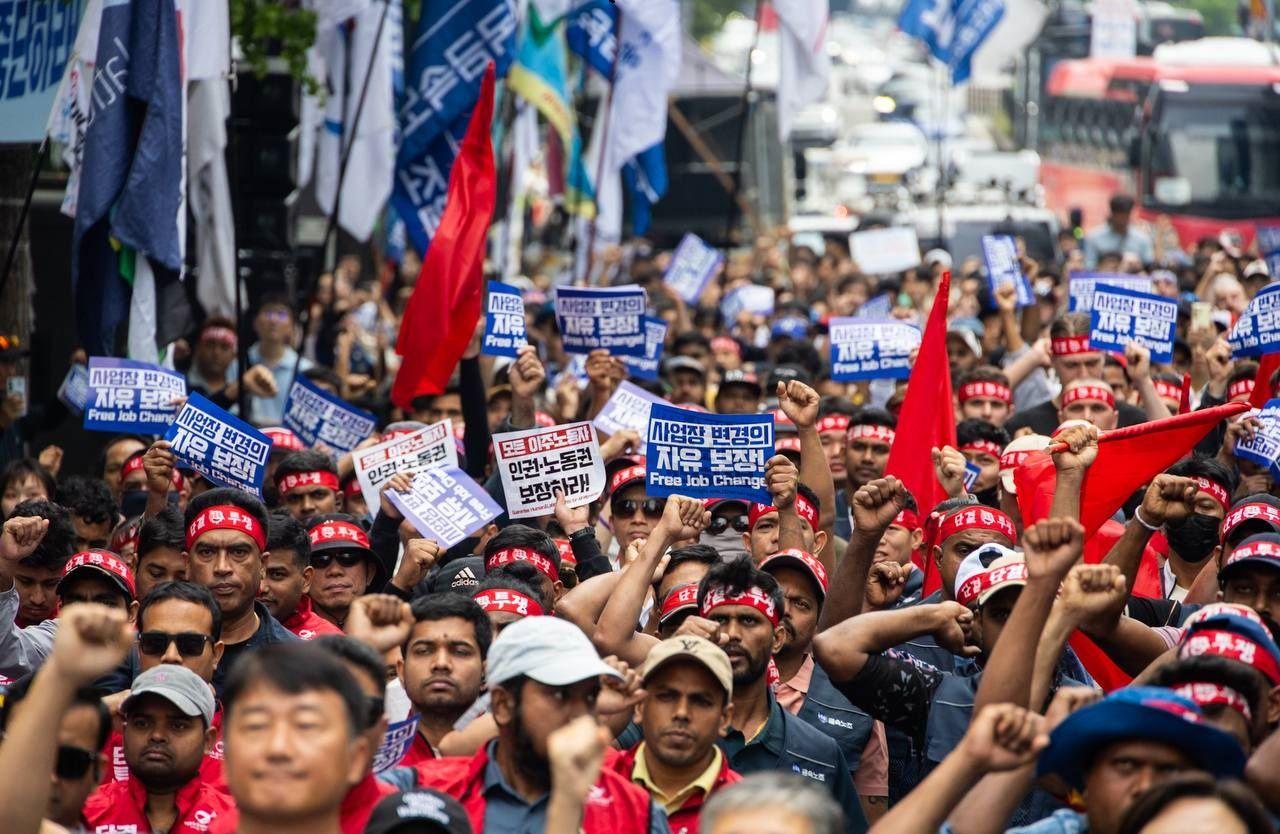
“사업장 변경의 자유를 보장하라!” 서로 다른 언어와 국적의 노동자들이 서울 한복판을 가득 메우고, 고용허가제가 만든 차별과 통제에 맞서 힘차게 목소리를 높였다.
2026년 09월 18일지난 9월 13일 서울에서 열린 2026 전국이주노동자대회에 참여한 유학생 요나탄이 집회와 행진에서 보고 느낀 것을 글로 보내왔다. 사업장 변경의 자유를 외치는 이주노동자들의 목소리와, 국적과 언어를 넘어 함께 만들어간 연대의 풍경을 전한다. 영어로 보내온 원문과 번역본을 함께 싣는다.
우리는 쓰레기가 아니다 | 국경을 넘는 계급연대
지난 일요일(9월13일) 서울 도심의 거리에는 짙은 남색 모자 위에 ‘단결 / 투쟁’이라고 적힌 붉은 머리띠를 두른 익숙한 풍경이 펼쳐졌다. 그러나 이날 그 머리띠를 자랑스럽게 두르고 있던 것은 평소 노동자집회에서 흔히 볼 수 있는 한국인 ‘아저씨들’과 보다 세계 곳곳에서 온 젊은 노동자들이 더 많았다.
이날은 민주노총이 주최한 2026 전국이주노동자대회였다. 참가자들은 을지로 인근 서울지방고용노동청 앞에 모여 집회를 연 뒤 청와대까지 행진했다. 수백 명의 활동가들이 쏟아온 조직 활동의 노력이 곳곳에서 드러났고, 이날 대회는 이주노동자운동의 힘과 역량이 성장하고 있음을 보여주는 자리였다. 그것은 이주노동자 역시 인간이며, 무엇보다 노동자이기에 존엄한 존재로 대우받아야 한다는 분명한 선언이었다. 또한 한국 노동운동이 이를 붙잡을 수만 있다면, 연대의 가능성이 이미 우리 앞에 열려 있다는 분명한 신호이기도 했다.
요구
이날 대회의 핵심 요구는 단순했다. “사업장 변경의 자유를 보장하라!” 이 요구는 손팻말과 구호는 물론 노래와 몸짓 공연에서도 가장 두드러지게 등장했다.
한국의 현행 고용허가제 아래에서 이주노동자의 비자는 고용주에게 종속되어 있고, 직장을 옮기려면 관할 고용센터에 사업자 변경 신청을 한 후 허가를 받아야 한다. 고용주들은 이러한 사실을 잘 알고 있으며 이를 일상적으로 악용한다. 이주노동자들이 한국인 노동자보다 일터를 벗어나기 훨씬 어렵다는 점을 이용해 폭력과 비인간적인 노동조건을 감내하도록 만드는 것이다.
악덕 고용주에게서 벗어날 수 있는 유일한 방법이 미등록 체류자가 되는 것뿐인 경우도 많다. 이처럼 이주노동자의 비자 제도는 거의 봉건적인 관계를 만들어낸다. 심한 경우 이주노동자는 마치 농노처럼 고용주의 회사에 묶이게 된다.
한국의 제도는 국제노동기구(ILO)의 기준과 크게 동떨어져 있으며, 이날 “사업장 변경의 자유”라는 요구는 “강제노동을 철폐하라”는 요구와 함께 제기됐다. 사측은 이 제도를 어떻게 악용할 수 있는지 정확히 알고 있으며, 실제로 빈번하게 이를 이용한다.
개별 노동자의 차원에서 보면, 한국에는 실효성 있는 차별금지법이 없기 때문에 인종과 성별에 따른 차별과 폭력이 빈번하게 발생한다. 임금체불도 흔하게 벌어지며, 노동자들은 한국을 떠난 뒤에도 받지 못한 임금을 되찾기 위해 싸워야 하는 경우가 많다.
구조적 차원에서 기업들은 비정규직 노동자를 이용해 정규직 노동자를 통제하듯, 이주노동자를 이용해 한국인 노동자를 통제하려 한다. 실제로 이 두 가지 분할은 상당 부분 서로 겹쳐 있다. 비정규 고용계약 자체도 심각하게 착취적인 경우가 많지만, 그 안에서도 이주노동자는 한층 더 큰 피해를 입을 수 있다.
울산에서 영어를 가르치는 해이미시는 내게 이렇게 말했다. “우리가 일하는 많은 사업장은 가장 기본적인 노동법조차 무시합니다. 우리가 한국에서 자신의 권리나 법에 대해 아무것도 모를 것이라는 생각을 악용하는 거죠.”
이날 대회의 핵심 요구 가운데 하나는 이주노동자들이 한국인 노동자들과 동등한 법적 지위를 누릴 수 있도록 고용노동부의 일반적인 노동행정 체계 안에서 동등한 노동자로 인정받게 하는 것이었다. 정규직과 비정규직 노동자를 갈라놓는 것과 마찬가지로, 이주노동자와 한국인 노동자를 인위적으로 분리하는 것 역시 한국 노동운동을 가로막는 장애물이다.
연대
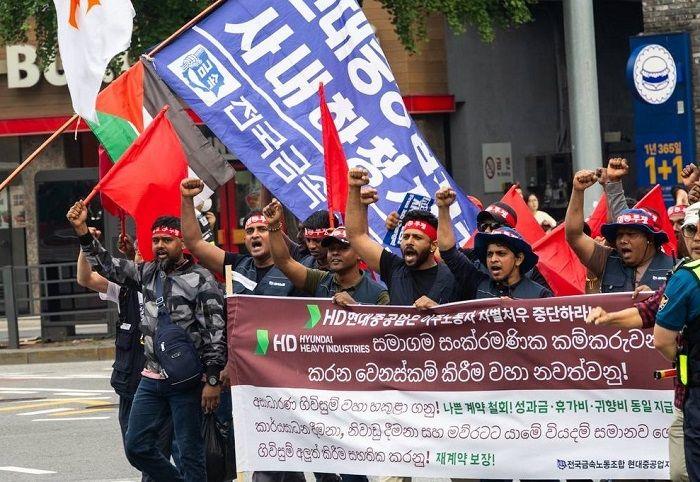
어떻게 보면 이러한 분리를 극복하는 방법은 이미 이날 대회에서 실천되고 있었다.일부 선진국의 노동운동이 이주민 혐오에 편승하며 스스로를 욕되게 한 것과 달리, 비정규직과 정규직, 이주노동자와 한국인 노동자 사이의 분할은 계급적 단결을 통해 넘어설 수 있다.
한국 노동운동은 역사적으로 이 문제를 해결하는 데 어려움을 겪어왔고, 민주노총과 같은 주요 노동조합 조직 역시 비정규직과 이주노동자들을 충분히 조직하고 대표하지 못한 경우가 많았다. 이런 현실을 알고 있었기에, 이날 대회에서 그토록 많은 이주노동자와 한국인들이 함께 서 있는 모습을 보고 나는 무척 반갑고 놀라웠다.
어쩌면 이것이 노동운동의 긍정적인 변화를 만들어낼 씨앗이 될지도 모른다.
고용주들은 한국의 비자 제도를 등에 업고 서로 다른 이주민 공동체를 출신국가와 민족에 따라 노동자들을 분할해 배치하기도 한다. 어느 정도는 이러한 분할이 이날 대회에서도 보였다. 남아시아 출신 철강 노동자들, 동남아시아 출신 농어업 노동자들, 서구권 출신 언어 강사들 등이 각기 눈에 띄었다. 그러나 우리가 비슷한 문제를 안고 같은 공간에 함께 서 있다는 사실 자체가 강력한 힘을 만들어냈다.
특히 이날 대회에서 한국어가 공통어로 사용됐다는 점이 인상 깊었다. 영어가 모국어인 나는 한국인이 아닌 참가자가 많은 집회나 행사에서는 자연스럽게 영어를 공통어로 사용하는 것에 거의 익숙해져 있었다. 나에게는 편리한 일이지만, 이는 결과적으로 ‘한국인의 행사’와 ‘외국인의 행사’를 서로 분리하는 효과를 낳을 수도 있다. 반대로 이번 대회를 대부분 한국어로 진행한 것은 이주노동자들과 한국인 노동자들이 서로를 이해하고 연결되는 관계를 오히려 더 가깝게 만들었다.
그렇다고 해서 이번 대회가 한국어로만 진행된 것은 아니었다. 여러 언어가 함께 사용됐다. 구호는 주로 한국어로 외쳤고 일부는 영어로도 진행됐지만, 각 노동조합 대표들의 발언이 시작되자 이주노동자들의 다양한 배경이 뚜렷하게 드러났다.
벵골어와 우즈베크어, 영어로 진행된 발언은 한국어로 통역됐고, 마지막 요구안은 이 언어들뿐 아니라 태국어, 미얀마어, 베트남어로도 낭독됐다. 일부 발언자는 긴장한 나머지 실제로 몸을 떨고 있었지만, 자신의 언어로 자신과 동료 노동자들을 위해 목소리를 낼 용기를 냈다.
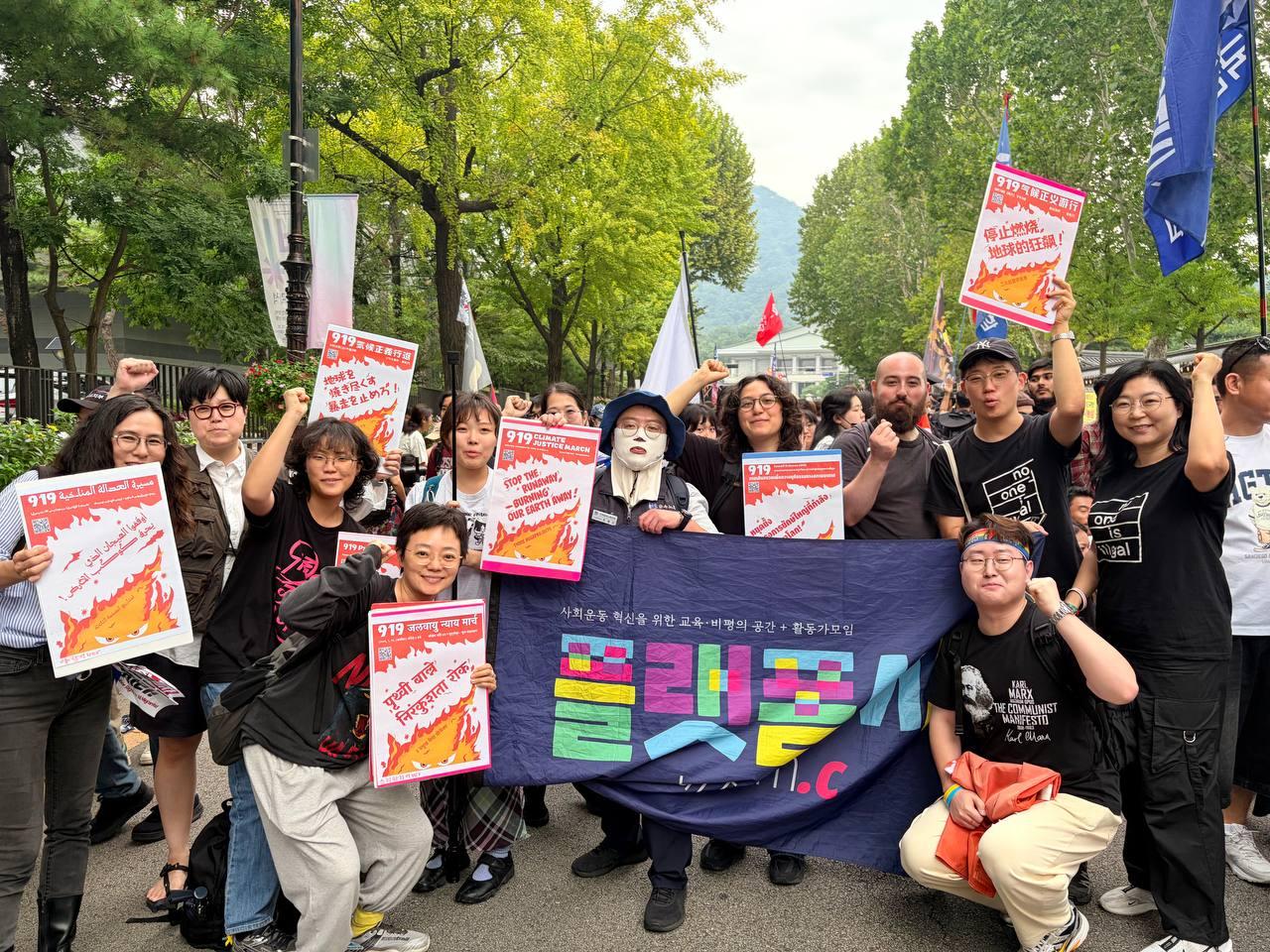
대회는 지난달 홍수 참사로 목숨을 잃은 네팔 사람들을 추모하는 묵념으로 시작됐다. 이는 기후정의 역시 국제적인 계급연대의 일부라는 사실을 다시 일깨워주었다. 행진 중 플랫폼C 활동가들은 곧 열릴 9·19 기후정의행진을 알리는 여러 언어의 손팻말을 들고 이러한 메시지를 전했다. 전 세계 에너지 부문 탄소배출에서 차지하는 몫이 극히 작은 네팔의 노동자들이 기후재난의 가장 큰 피해를 떠안고 있다. 한국에서 살아가는 그들의 가족과 다른 이주노동자들 역시 마찬가지로 가혹한 현실을 마주하고 있다.
허술한 천막이나 이동식 숙소에서 잠을 자야 했던 이주 농업노동자 여러 명이 이번 여름 열사병과 탈수로 목숨을 잃은 채 발견됐다. 기후재난이 더욱 심각해질수록 글로벌 사우스에서 한국과 같은 나라로 이주하는 사람들은 늘어날 것이며, 이에 따라 한국의 노동 투쟁에서도 이주노동자 문제는 더욱 중심적인 과제가 될 것이다.
집회 말미에 내가 미처 마음의 준비를 하지 못한 일이 벌어졌다. 집회 참가자 전원이 일어서서 「인터내셔널가」를 부른 것이다. 나는 이 노래를 한국어로 들어본 적이 없었다. 나는 원래도 감정이 풍부한 편이지만, 이 순간 특히 깊이 울컥했다. 이곳에는 진정으로 세계적인 노동계급이 한자리에 모여 자신의 해방을 노래하고 있었다. 한국에서는 자주 보기는 힘든 금속노조의 붉은 깃발들이 펄럭이며 이 장면을 더욱 인상적으로 만들었다. 내 뒤에 앉아 있던 영어 강사들은 자신의 한국어 실력이 부족하다고 거듭 말했지만, 놀라울 만큼 열정적으로 노래를 따라 불렀다.
발언자들은 노동자의 존엄에 대해 이야기했다. 이주노동자는 착취하다가 쓸모가 없어지면 나라 밖으로 내쫓는 쓰레기도, 일회용품도 아니라고 말했다. 이 노래를 부르는 동안 나는 그 존엄과 자부심을 내 몸으로 직접 느꼈다. 우리는 당당히 서 있었고 두려워하지 않았다. 그 순간만큼은 이 체제 전체와 싸워 이길 수도 있을 것 같은 기분이 들었다.
「인터내셔널가」에 이어 「임을 위한 행진곡」이 울려 퍼졌다. 여러 면에서 지극히 한국적인 이 노래를 이렇게 다양한 사람들이 함께 부르는 모습은 특별한 의미로 다가왔다. 한국에서 일하는 이주노동자들은 과거 한국 노동자들이 벌여온 투쟁에 경의를 표하고 있었다. 과거의 승리와 희생은 한국인들만의 유산이 아니라 전 세계 노동자들이 함께 물려받은 유산이다.
열기
나는 집회가 요구를 평화적으로 표현하는 자리라면, 적어도 참가하는 재미는 있어야 한다고 늘 생각해왔다. 영국에서 지루함과 우울함이 뒤섞인 집회와 행진에 참가했던 괴로운 기억이 내게는 많다. 반면 이날 대회는 처음부터 끝까지 높은 에너지가 이어졌다. 초반의 노래와 묵념처럼 엄숙한 순간들조차 사람들을 북돋우는 힘이 있었고, 집단적인 존엄의 감각으로 가득했다.
물론 즐거운 순간도 많았다. 귀에 쏙 들어오는 ‘Free Job Change’ 노래에 맞춘 율동 공연이 펼쳐졌고, 참가자들은 마치 콘서트에 온 것처럼 박수를 치고 깃발을 흔들었다. 청와대까지 이어진 행진 역시 활기가 넘쳤고, 구호와 현수막은 거리를 지나는 시민들의 시선을 사로잡았다. 한국 사회에서 이주노동자들은 종종 잘 보이지 않는 존재, 생각조차 하지 않는 존재로 밀려난다. 하지만 이날 서울 한복판에서 그들의 존재는 결코 외면할 수 없을 만큼 선명했다.
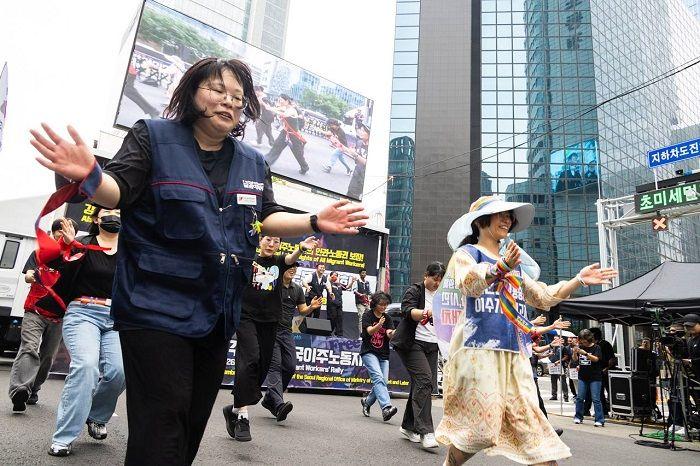
유쾌하고 재치 있는 장면들도 많았다. 행진 마무리 장소인 청와대에서는 우리가 들고 있던 손팻말을 종이비행기로 접어 대통령 관저를 향해 날리기도 했다. 집회와 행진은 귀를 울릴 만큼 힘찬 소리로 가득했고, 그 소리의 한가운데에는 끊임없이 이어지는 ‘투쟁!’이라는 외침이 있었다.
한국 노동자 집회의 전통답게, ‘투쟁’이라는 말은 사람들이 착용하고 있는 머리띠들 곳곳에 적혀 있었고 모든 발언의 끝에 등장했으며 집회 내내 거듭 외쳐졌다. 한국어를 많이 알지 못해도, 아니 전혀 알지 못해도, 이 말이 가진 힘을 느끼는 데에는 아무런 문제가 없었다.
이날 집회에서 ‘투쟁’은 서로를 북돋는 외침이자 반복해서 되새기는 다짐이었고, 옆에 있는 사람들과 함께하겠다는 약속이기도 했다. 그것은 ‘나도 인간이고, 당신도 인간이다’라는 선언이었다. 또한 지금 각자가 어떤 처지에 놓여 있든, 더 나은 무언가를 위해 함께 싸우는 것이 언제나 더 낫다는 것을 확인하는 말이었다. 여기서 말하는 ‘더 나은 무언가’란 이주노동자와 한국인 노동자가 온전하고 평등한 인간으로서 존엄하게 함께 살아갈 수 있는 더 나은 미래다.
이날 집회에 많은 한국의 사회운동 활동가들이 함께한 모습은 고무적이었다. 하지만 이러한 연대의 관계는 지금보다 더 깊어지고 지속적으로 이어질 필요가 있다. 이주노동자와 한국인 노동자 사이뿐 아니라 서로 다른 이주민 공동체 사이에서도, 노동계급이 출신과 민족에 따라 분할되는 현실을 깨뜨리기 위한 노력 역시 더욱 강화되어야 한다.
이는 정규직 노동자와 비정규직 노동자 사이의 연대를 더욱 강화해야 한다는 과제와도 연결되어 있다. 이 과정에서 한국의 사회운동은 지역에서 이주민 공동체 및 노동조합과 관계를 맺는 데 더 적극적인 역할을 할 수 있다. 동시에 전국적 차원에서는 민주노총이 맡아야 할 분명한 역할이 있다.
민주노총이 이번 대회를 주최했지만, 이주노동자들의 민주노총 조직률은 여전히 낮은 편이며 이주노동자 조직화에 투입되는 자원 역시 그동안 제한적이었다. 이를 바로잡는 것은 지금 당장의 과제다. 자본과 국가가 그어놓은 경계에 따라 노동계급이 분열되는 것에 맞서는 것은 국제 노동자운동이 역사적으로 짊어져 온 책무이기도 하다.
글 : 요나탄 (유학생)
번역 : 민희
We are not Trash | Class Solidarity Across Borders at the National Migrant Workers’ Rally
A familiar sight of red bandanas, emblazoned with ‘Unite / Struggle’ and wrapped around dark blue sunhats, graced the streets of central Seoul last Sunday. Rather than the usual troop of Korean middle-aged Korean men, however, these bandanas were worn proudly by young workers from every corner of the world. This was KCTU’s 2026 National Migrant Workers’ Rally. Gathering first at the Seoul Regional Office of the Ministry of Employment & Labor near Euljiro, it was a rally followed by a march to Cheong Wa Dae. The hard organising work of hundreds of activists was on display, and the rally was a testament to the growing power and capacity of the migrant workers’ movement. It was a clear declaration that migrant workers are human too and deserving of dignity because they are workers. Moreover, it was a clear signal that the opportunities for solidarity are there, if the Korean workers’ movement is able to take them.
Demands
The central demand of the rally was simple: ‘Free Job Change!’. This featured prominently on placards, in chants, and even a song & dance performance. Under Korea’s current Employment Permit System, migrant workers are tied to their employer through their visa and must re-apply for a work visa if they want to change their job. Under Korea’s current Employment Permit System, migrant workers’ visas are tied to their employers, and if they want to change workplaces, they must apply for a workplace change at the relevant employment center and receive approval. Often the only way to escape a bad boss is to become undocumented. The migrant visa system thus creates an almost feudal relationship where, in the worst cases, migrant workers are tied to their bosses’ companies like serfs. Korea’s system is completely out of step with the ILO’s standards, and the ‘Free Job Change’ demand was paired with a call to ‘Abolish Forced Labour’.
Bosses know exactly how to exploit this system and do so frequently. On an individual level, Korea’s lack of real anti-discrimination legislation means that racial and gender-based abuse are frequent. Wage theft is commonplace, and workers are often left fighting for unpaid wages even after leaving Korea. On a systemic level, companies try to use migrant labour to discipline Korean workers, just as irregular workers are used to discipline regular workers; in fact, these two divisions often overlap considerably. Irregular contracts are often deeply exploitative, but migrant workers can be harmed further within them. Hamish, an English teacher in Ulsan, explained to me that “many of our workplaces flout the most basic of labour laws and take advantage of the assumption that we don’t know anything about our rights or the law in Korea”. One core demand of the rally was the regularisation of migrant workers under the Ministry of Labor, so they can be on the same legal footing as Koreans. Just as with the division of regular and irregular workforces, the artificial separation of migrant workers from Korean workers is a hindrance for the Korean labour movement.
Solidarity
In a way, the solution to this separation was already being practiced in the rally itself. While some labour movements in developed countries have disgraced themselves by leaning into anti-migrant sentiment, the divisions between irregular & regular and migrant & Korean workers can be overcome by uniting on a class basis. The Korean labour movement has historically struggled with this, and mainstream union organisations like KCTU have often been under-represented among irregular and migrant workers.
Knowing this, I was really pleasantly surprised to see so many migrant workers and Koreans standing together at this rally. Perhaps it might be the seed for a positive change in the labour movement. Employers also rely on an ethnic segmentation of labour between migrant communities, aided by the Korean visa system. To an extent this was visible in the rally itself – South Asian steel workers, South-East Asian farm and fisheries workers, Western language teachers, etc. – but the fact that we were all stood together, in the same space, and with similar grievances, was powerful.
The use of Korean as the lingua franca of the rally struck me. As a native English speaker, I had almost got used to rallies and events with lots of non-Korean attendees defaulting to English. This is convenient for me, but it can have the effect of separating ‘Korean’ and ‘foreign’ events.
By contrast, making the rally mostly in Korean ensured that the bonds of understanding between the migrant workers and their Korean counterparts were actually closer. That said, this rally was still a multilingual event. Chants were mainly in Korean, with some in English, but as speeches by individual union representatives began the diversity of the migrant workers was apparent. Speeches in Bengali, Uzbek, and English were translated into Korean, and a final statement of demands was read out in these languages as well as Thai, Burmese, and Vietnamese. Some of the speakers were literally shaking with nerves, but found the courage to speak up for themselves and their fellow workers in their own languages.
The rally opened with a moment of silence for the people of Nepal who had been killed in the flooding disaster last month. This was a reminder that climate justice is a part of international class solidarity. During the march, Korean Social Movement Organization PlatformC activists carried this message via placards in several languages about the upcoming 919 Climate Justice March demonstration. The workers of Nepal, who contribute such a tiny proportion of global energy emissions, are bearing the brunt of climate disaster. Their relatives and other migrant workers in Korea face a similarly harsh deal.
Several migrant farm workers, often sleeping in flimsy tents or caravans, were found dead this summer from heatstroke and dehydration. As climate catastrophes accelerate more migrants from the Global South will come to countries like Korea, further centring migrant issues within the labour struggle here.
I was not quite prepared for what came next. The whole rally stood for a rendition of The Internationale, which I had never heard before in Korean. I’m quite a sentimental person anyway, but I was deeply moved. Here was a truly global working class, gathered in one place, singing about its own liberation. The red flags waved by the metal workers’ union, also a rare sight in South Korea, added to the spectacle. Despite insisting that their Korean was limited, the English teachers sitting behind me sang along with impressive enthusiasm.
The speeches talked about dignity for workers, how migrant workers are not trash or single-use items to be exploited then kicked out of the country; during this song I felt that dignity and pride personally. We were upright and unafraid, and in that moment I felt like we could fight the entire system and win. ‘The Internationale’ was followed with ‘March for the Beloved’. This song, so very Korean in many ways, being sung by such a diverse crowd felt meaningful. The migrant workers of Korea were paying homage to the struggles of the Korean workers of the past. Those past victories and sacrifices are a heritage not just for Koreans but for the workers of the whole world.
Energy
I have always thought that if a demonstration is a peaceful expression of demands, it should at least be fun to participate in. I have many painful memories of rallies and marches in Britain which were a mix of boring and depressing. This rally, by contrast, had consistently high energy throughout. The sombre moments, like the initial songs and moments of silence, were still uplifting and filled with a sense of collective dignity. There were, however, plenty of fun moments as well. A whole dance performance was built around a catchy song (‘Free Job Change’), and the attendees clapped and waved their flags like at a concert. The march to Cheong Wa Dae was energetic, with chants and banners grabbing the attention of the public. Migrant workers are so often placed out of sight and out of mind in the Korean imagination; here they were unmissable in central Seoul.
Whimsical elements abounded too, as at Cheong Wa Dae we folded our placards into paper aeroplanes and threw them towards the Presidential residence. The rally and march were unmissably loud, and part of that noise was the constant chanting of ‘Struggle!’. In the tradition of Korean labour rallies, this word was on every bandana, at the end of every speech, and chanted and shouted repeatedly. You don’t need to speak much (or any) Korean to appreciate it. ‘Struggle’ in this rally was simultaneously a shout of encouragement, a mantra, and a promise to stand with the people next to you. It was a declaration that I am human, and so are you. It was an acknowledgement that no matter your current circumstances, it is always better to fight together for something more.
That ‘something more’ in this case is a better future where migrant workers and Korean workers can live together in dignity as full and equal human beings. It was encouraging to see so many Korean social movement activists present at the rally, but these connections can be made deeper and more consistent. So too can efforts to break the ethnic segmentation of the working class, both between migrants & Koreans and between different migrant communities.
This is linked to the need to build greater links between regular and irregular workers. Here the Korean social movements can play a stronger role in building local connections with migrant communities and unions, but at a national level KCTU also has a clear role to play. While they hosted the rally, their density among migrant workers and resource allocation towards their organising has often been limited. Rectifying this is an immediate task, and resisting the division of the working classes along lines drawn by the bosses and the state is an historic duty of the international workers movement.