


Why was the demand to be treated like humans met with death?
2026년 4월 28일
On April 20th, the head of the Jeonnam Container Branch of the Jeonnam Regional Headquarters of the Korean Public Service and Transport Workers’ Union Cargo Truckers Solidarity Division (KPTU-TruckSol) was struck and killed by a company-owned transport vehicle while participating in strike demonstrations at the CU Jinju Logistics Center in Gyeongnam. This article, which documents the scene of tragedy at the hands of both state forces and the principal contractor, was also published on OhmyNews. The article has been supplemented with additional information for our international readers who are less familiar with the current state of the South Korean labor movement.
CU is a convenience store franchise that currently operates the most convenience store locations of any franchise in South Korea (18,700 locations). The company has also expanded to Mongolia (500 locations), Malaysia (170 locations), Kazakhstan (28 locations), and operates two stores in Hawaii. The parent company, BGF Retail, develops the business plan and outsources logistics operations to its subsidiary, BGF Logis. BGF Logis then outsources the storage and sorting of goods to 37 subcontracted logistics centers across the country, and the centers then subcontract the work to hundreds of transportation companies. There are approximately 3,500 cargo truck workers who deliver canned beer and ice cream to CU convenience stores. The late Seo Gwang-seok, who was struck and killed by a company vehicle, was a longtime labor movement leader with KPTU-TruckSol and one of these 3,500 workers.
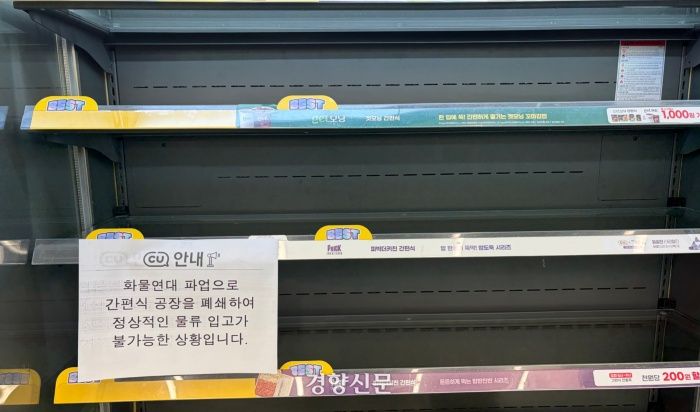
The Cargo Truckers Solidarity Division (TruckSol) is an affiliate of the Korean Public Service and Transport Workers’ Union (KPTU), the largest industrial union affiliated with the Korean Confederation of Trade Unions (KCTU), and is composed of ‘special employment’ contract workers who own and drive their own cargo trucks. These cargo transportation workers are fighting to protect their livelihoods and ensure road safety. They have been calling for the establishment and expansion of the Safe Trucking Freight Rates (Safe Rates) system, which guarantees a minimum freight rate to prevent overloading and speeding. Notably, in 2021 and 2022, they launched large-scale general strikes demanding the abolition of the sunset clause for the Safe Rates system and the plan’s full implementation. However, due to the government’s hardline response—including the issuance of an unconstitutional work resumption order (to halt the strike), a first in South Korea’s history—the union suffered a significant decline in membership following the strikes. As a result, KPTU-TruckSol continues to face a severe crisis and the challenge of securing labor rights.
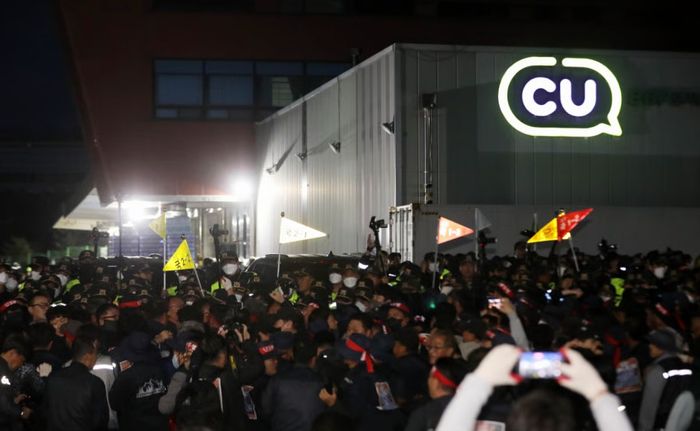
April 20th, 2026, 8:30 p.m. I visited the last site of struggle for the late Seo Gwang-seok, a member of the Korean Public Service and Transport Workers’ Union Cargo Truckers Solidarity Division (KPTU-TruckSol), 10 hours after the tragedy occurred. Police buses were lined up at every turn along the road leading to the CU Logistics Center. At the intersection leading to the site, police were directing traffic. As I approached the logistics center, I began to see vehicles bearing the names ‘TruckSol Branch ○○’ alongside the police buses, and in the distance, I could hear a loudspeaker blaring, “Save Seo Gwang-seok!”
At the main gate of the CU Logistics Center, hundreds of KPTU-TruckSol members, politicians from the Justice Party, Progressive Party, and other progressive parties, and citizens gathered in solidarity. Alongside collapsed fences, the cries of KPTU-TruckSol members, who stood in a standoff with police forces blocking the gate, showed the visceral anger of the union members who lost a comrade. “Those people are murderers!” they shouted.
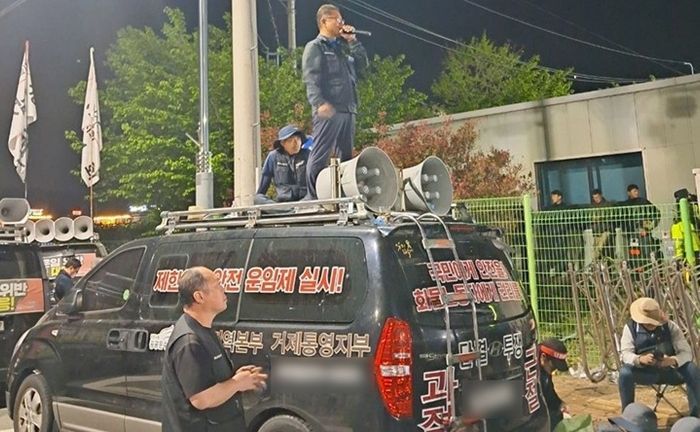
Director of the KPTU-TruckSol Incheon Regional Headquarters Kim Ji-hwan, who stood atop the broadcast van, raised his voice. “This is clearly a murder committed by state forces. It was the so-called democratic police—who are supposed to protect workers—who caused comrade Seo Gwang-seok to be run over by a car.” Director Kim lamented, “KPTU-TruckSol has already lost three martyrs, Choi Bok-nam, Kim Dong-yoon, and Park Jong-tae. Now another has been martyred. How can this be? The anti-strike vehicle ran over martyr Seo Gwang-seok, then backed up and ran him over again. Does this make any sense?” and cried, “Long live Seo Gwang-seok. You killed Seo Gwang-seok. You are all accomplices.” Hundreds of KPTU-TruckSol members responded with a chorus of cries. It was the first time in 17 years, since Park Jong-tae was martyred in 2009, that a member of the KPTU-TruckSol had lost their life during a protest.
A murder by state forces
Bae Yong-soo, director of the KPTU-TruckSol Chungbuk Regional Headquarters, who had been at the strike site since the morning, said, “The loss of life was due to the police’s use of force.” Director Bae said, “In the morning, there were only around 30 union members, but the police were clearing the road for the anti-strike vehicle, and in that process, a tragedy occured.” He also asserted, “I heard there had been an accident, so I tried to go to the scene, but the police blocked my way, banging on the wall. When I finally managed to get through and saw the scene, they hadn’t even called 119 and were neglecting the tragedy.”
“After he was taken in an ambulance, I thought he’d be okay,” Director Bae said, “but at around 11:45, I heard that he had been pronounced dead.” Crying in frustration, he said, “The police are working as pawns of BGF. We are also citizens, and we pay taxes. How can they drive us to our deaths like this?”
“Our negotiation conditions are simple. We want to be able to share meals with our children at home. We work up to 15 hours a day, so we’ve simply asked the principal contractor to exempt us from sorting and stocking duties—tasks that even delivery workers at other convenience stores don’t have to do—and to raise logistics fees to reflect current realities,” Director Bae added. “At the rally in Jincheon on the 18th, one union member expressed, ‘Human beings are not meant to work like this. We joined the union because we want to live like humans.’ We want to be able to live like humans. Is this really something we should have to risk our lives for?”
“Someone has died, but the company has not even offered a token apology,” Director Bae said. He pointed at the front gate of the logistics center. “What are those young police officers guilty of? Aren’t they just following orders from above? The Jinju Police Station and Gyeongnam Police Station leadership are at fault,” he added.
Behind Director Bae, the 2.5-ton truck that had hit the deceased was visible. The vehicle, which had been blocked in by KPTU-TruckSol trucks to prevent the police from towing it, was surrounded by clear evidence marking the scene of tragedy.
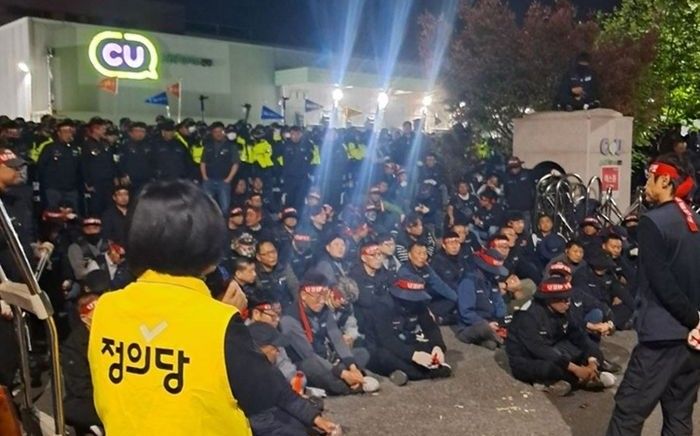
We demand apologies from the Ministry of the Interior and Safety and the Ministry of Employment and Labor
Also present at the scene that day was Kang Eun-mi, a Justice Party mayoral candidate for Gwangju, Jeonnam, who described herself as a 30-year-long friend of the deceased. Candidate Kang, who recently encountered comrade Seo Gwang-seok at a sports festival held by the Gwangyang branch of KPTU-TruckSol, said, “He remembered something I had helped him with over 30 years ago—something I didn’t even recall myself—and said he wanted to repay that debt this time. He went around the tents introducing me.” She added, “He was a truly warm-hearted person and comrade who fought more passionately and vigorously than anyone else for workers’ issues.”
“I heard the news today and could not believe it. I can still clearly hear that voice from a few days ago, saying, ‘Comrade Kang Eun-mi, it’s nice to see you,’ and smiling broadly,” Candidate Kang said. “Is South Korea really an advanced country? How can an advanced country so ruthlessly trample on a request to simply let families have one meal together during the holidays? Is it asking too much to add one more day to the two-day summer vacation?”
Candidate Kang went on to urge, “The Ministry of the Interior and Safety and the Ministry of Employment and Labor must come to the scene and apologize to the bereaved families and the families of KPTU-TruckSol,” adding, “I will fight alongside these cargo workers—who are responsible for the safety of many citizens and industries—to support their just demands until the very end. I will stand with you to ensure that the truth behind comrade Seo Gwang-seok’s unjust death is fully uncovered and those responsible are punished.”
At the town hall at the Changwon Exhibition Convention Center in Gyeongnam on February 6th, President Lee Jae-myung responded to a worker who voiced grievances about “wage disparities and poor working conditions,” saying, “The three rights of labor (the right to organize, the right to collective bargaining, and the right to collective action) are guaranteed by the constitution,” and urged people to “work hard for the labor movement.” The cargo truck workers did as the president said and worked hard for the labor movement, yet a person died while the police stood by and watched. In a country where an amendment to the Labor Union Act—which enables negotiations with the principal contractor—has taken effect, a worker who demanded such negotiations lost his life in a horrific manner. The government must take responsibility for his death.
On April 28th, KCTU held a large-scale rally under slogans such as “Keep the spirit of martyr Seo Gwang-seok alive!”, “Condemn murder by the state forces!”, and “Condemn CU BGF for evading direct negotiations!” On the upcoming Labor Day, large-scale worker rallies are planned in front of the BGF Retail headquarters in Gangnam, Seoul, and freight logistics centers across the country.
Writer: Seongwoo Park (Activist at Eumseong Labor Human Rights Center)
Translator: Eunhye (Platform.C member)